
Running advertisements through Meta Ads Manager does not automatically produce good results.
A campaign may receive impressions and clicks but still fail to generate valuable leads or sales. In many cases, the problem is not the platform itself but the strategy behind the campaign.
Businesses sometimes choose the wrong objective, communicate an unclear offer, overlook their landing pages, or make decisions without reviewing meaningful performance data.
Understanding these mistakes can help advertisers improve their campaigns and use their budgets more carefully.
Here are seven common Meta Ads mistakes and practical ways to avoid them.
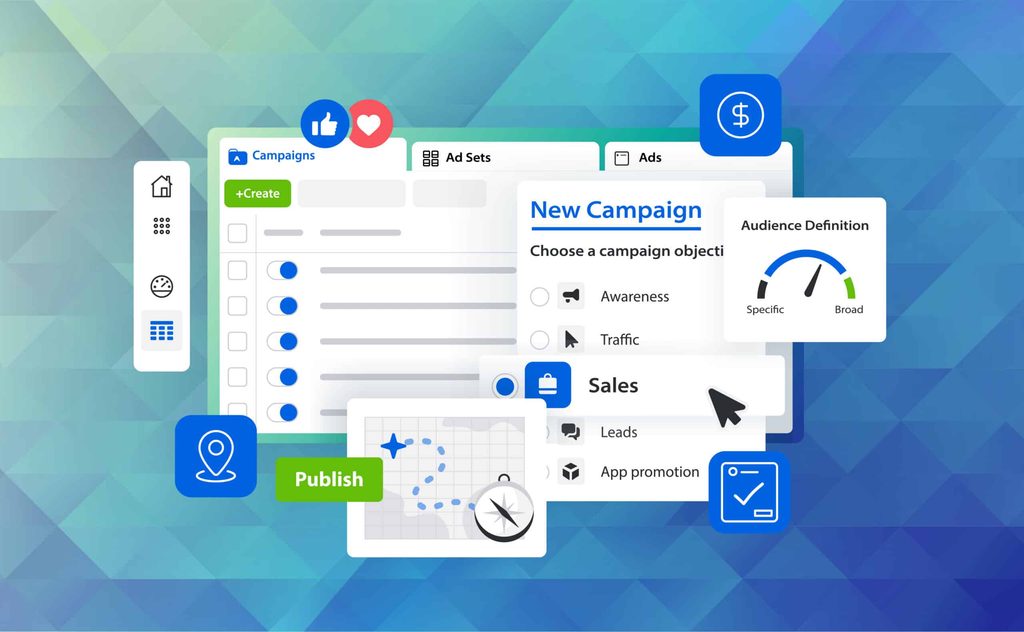
Mistake 1: Choosing the Wrong Campaign Objective
Every campaign should begin with a clear business goal.
If your main objective is to generate qualified leads, optimizing primarily for post engagement may not be the most suitable approach.
Similarly, a campaign intended to drive website traffic may attract visitors without necessarily producing purchases.
How to Avoid It
Identify the action that matters most to your business before creating the campaign.
Ask yourself:
- Do I want people to recognize my brand?
- Do I want relevant website visits?
- Do I want customer inquiries?
- Do I want purchases?
Choose the objective and optimization settings that best support that goal.
Mistake 2: Targeting the Wrong Audience
An advertisement can have excellent creative content and still perform poorly if it reaches people who are unlikely to be interested in the offer.
For example, advertising a local service to people outside the business’s service area can generate irrelevant traffic.
On the other hand, making an audience unnecessarily narrow can also limit opportunities.
How to Avoid It
Start with a clear understanding of your ideal customer.
Consider their location, needs, buying behavior, and the problem your offer solves. Use available audience tools appropriately and review actual campaign results.
Avoid assuming that a long list of interests automatically creates a better audience.
Mistake 3: Using Weak Ad Creatives
People encounter a large amount of content on social platforms. An unclear or unappealing advertisement may struggle to communicate its value.
Common problems include poor image quality, too much text, weak headlines, and offers that are difficult to understand.
How to Avoid It
Create advertisements that communicate one main benefit clearly.
Use relevant images or videos, concise copy, and a clear call to action.
For example, instead of writing only “Best Digital Marketing Services,” explain what the service helps a customer achieve and invite them to take a specific next step.
Test different creative approaches when you have a clear reason to compare them.
Mistake 4: Ignoring the Offer
Sometimes the advertisement is not the main problem. The offer itself may be unclear, irrelevant, or uncompetitive.
A well-designed campaign cannot automatically make an unsuitable offer attractive to customers.
How to Avoid It
Before launching, make sure your offer answers these questions:
- What exactly does the customer receive?
- Who is the offer intended for?
- Why is it useful?
- What does it cost, where relevant?
- What should the customer do next?
Make sure the information in your advertisement matches the information on your landing page or lead form.
Mistake 5: Focusing Only on Cheap Leads
A low cost per lead may look impressive, but it does not always indicate a successful campaign.
Suppose Campaign A generates 50 leads at ₹100 per lead, while Campaign B generates 20 leads at ₹150 per lead.
Campaign A costs ₹5,000, while Campaign B costs ₹3,000. However, if Campaign B produces more paying customers, it may deliver better business value despite having a higher cost per lead.
The example is illustrative; actual results will vary.
How to Avoid It
Track lead quality and follow-up outcomes, not just the number of form submissions.
Where possible, measure how many leads become qualified prospects, customers, and revenue.
Use these outcomes to decide whether a campaign is worth continuing.
Mistake 6: Neglecting Landing Pages and Follow-Up
Your advertisement is only one part of the customer journey.
If a landing page loads slowly, provides confusing information, or does not match the advertisement, potential customers may leave without taking action.
Likewise, a promising lead may lose interest if the business does not respond promptly.
How to Avoid It
Check that your landing page or lead form is easy to use, relevant, and functional on mobile devices.
Explain the offer clearly and remove unnecessary steps.
For lead generation, establish a reliable follow-up process so inquiries receive appropriate responses. Respect customer preferences and applicable privacy requirements.
Mistake 7: Making Changes Without Reviewing Data
Advertisers sometimes pause campaigns, change budgets, replace creatives, or modify audiences based on very little information.
This can make it difficult to understand why performance changes.
At the same time, leaving a campaign untouched when it is clearly spending without delivering useful results can also waste money.
How to Avoid It
Define your performance benchmarks before launching.
Review metrics relevant to the campaign objective, consider the amount of data available, and make changes based on evidence rather than assumptions.
Keep a record of important changes so you can compare performance before and after each adjustment.
A Simple Meta Ads Audit Checklist
Before launching or optimizing a campaign, review these questions:
- Is the campaign objective aligned with the business goal?
- Is the offer relevant to the intended audience?
- Is the ad creative clear and engaging?
- Does the destination work properly on mobile?
- Is the tracking setup appropriate?
- Are leads or sales being evaluated for quality?
- Is spending monitored against a defined budget?
- Are campaign decisions supported by sufficient data?
If you identify a problem, prioritize the issues most likely to affect your business outcome rather than changing everything at once.
Conclusion
Meta Ads performance depends on the relationship between your objective, audience, offer, creative, destination, and measurement process.
Avoiding these seven mistakes will not guarantee success, but it can help you make more informed advertising decisions and reduce preventable waste.
The most effective approach is to set clear goals, monitor meaningful metrics, learn from campaign data, and improve one part of the customer journey at a time.